
From the Frontline
Nine Floors High and Ninety Wide: Inside "Neon Over Monolith"
Published November 6, 2026 · by Anton Ignatov
The song behind the story
Neon Over Monolith
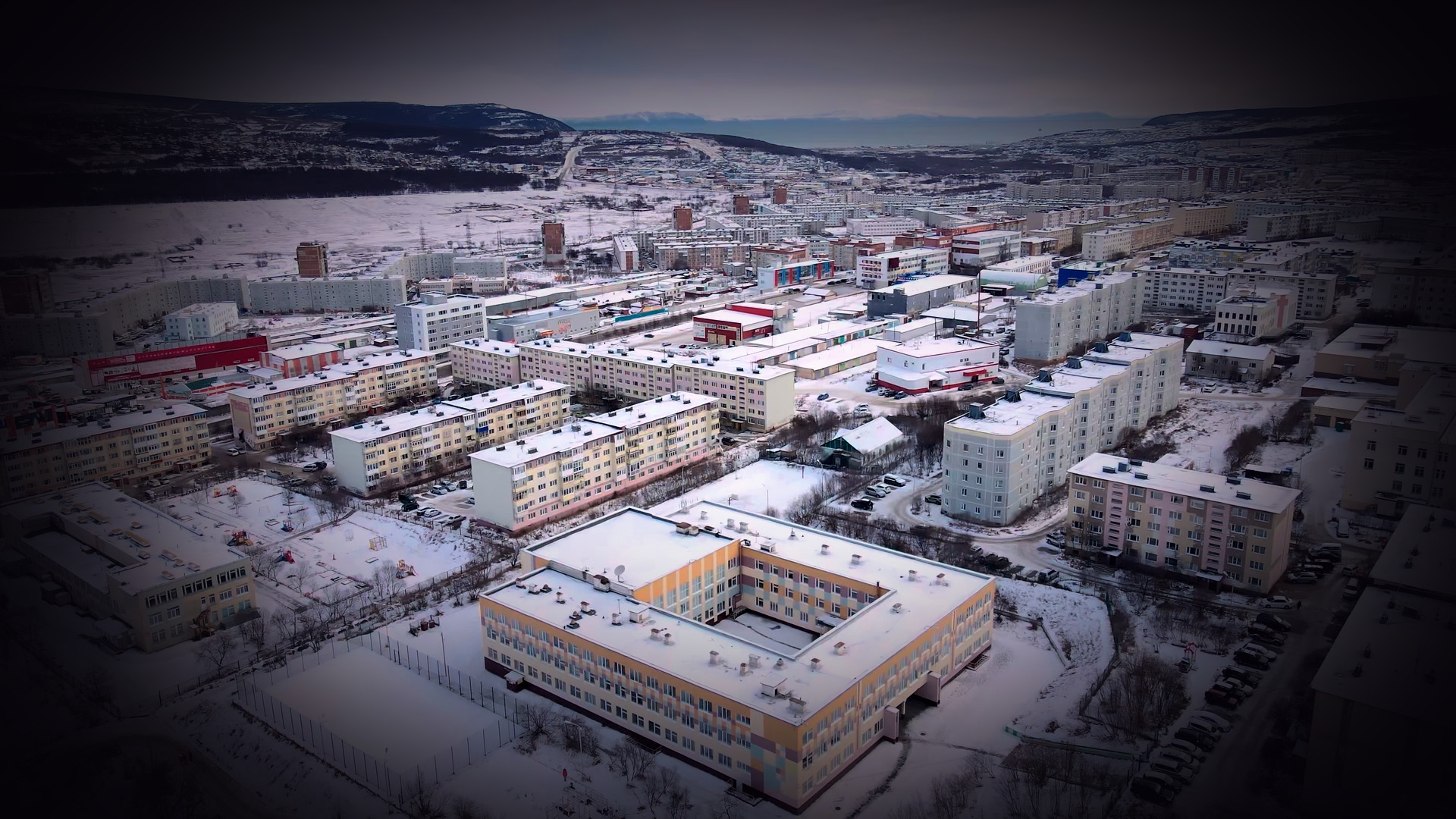
From the air, the city looks like a circuit board that someone built and then forgot to label. Identical blocks. Identical courtyards. Identical white roofs. Snow fills the spaces between them. A road comes in, circles once, and leaves. There is no center, because every part of it is the center.
Then the camera drops. Street level. A courtyard. A lamp. A wall of gray panels going up into the dark, and at the bottom of it, a grocery store with its sign on.
Nine Floors High and Ninety Wide
"Gray on gray on gray again / Nine floors high and ninety wide / Every window, every stair / Built the same on every side."
The snow comes down like static. It swallows the road, the playground, the rooftops, the sound of the city. The blocks stand in it and hold their breath.
They came in pieces: factory panels, standard sections, a crane, a schedule. From 1956 into the 1970s, the USSR built apartments the way other countries built cars. First the five-story khrushchevka — walk-up, low ceiling, a kitchen you could cross in two steps, a bathroom where the tub and the toilet shared a room. Then the nine-story brezhnevka, with an elevator, a garbage chute, and a little more space. Same seams. Same stairwells. Same window over the same courtyard, repeated until the map looked like a print run.
Inside, the kitchen is a corridor with a table. The radiator ticks. The window fogs. There is a closet by the door for coats and a balcony that becomes a refrigerator in October: jars, frozen meat, a bag of apples. Someone downstairs is frying onions, and the smell climbs the stairwell to every floor.
The promise was simple: a door of your own. A kitchen of your own. A window. For a family coming out of a communal flat, that was not a small thing. It was everything. The bill arrived later, in gray.
Block Eleven, Block Eleven
"Block eleven, block eleven / Or the one I passed before / Same gray light and same gray walls / Same old echo down the hall."
Walk into any courtyard at midnight. Sodium lamps. A car idling with its lights off. Laundry frozen stiff on a balcony. Somewhere a dog, somewhere a television. The stairwell smells of wet wool, cigarettes, and the dust on a radiator. Your boots knock on concrete and the echo knocks back.
Soviet planners called the unit a microdistrict: ten to sixty hectares, eight to twelve thousand people, a school, a kindergarten, a clinic, a grocery store, all within a five-hundred-meter walk. No through traffic. Everything you needed, inside the same gray frame. A humane idea drawn at a scale that could not stay humane.
So the addresses blur. Block eleven, or the one you passed before. The same school, the same store, the same wall. In The Irony of Fate (1976), a man gets drunk in a Moscow bathhouse, is put on a plane to Leningrad by mistake, and lets himself into a stranger's flat with his own key. Same street name. Same building number. Same furniture, almost. The joke is not that he is lost. The joke is that he is home.
One Broken Letter Holding Up the Night
"Then something flickers, pink in the dark / A crackle, a hum, a stutter, a spark."
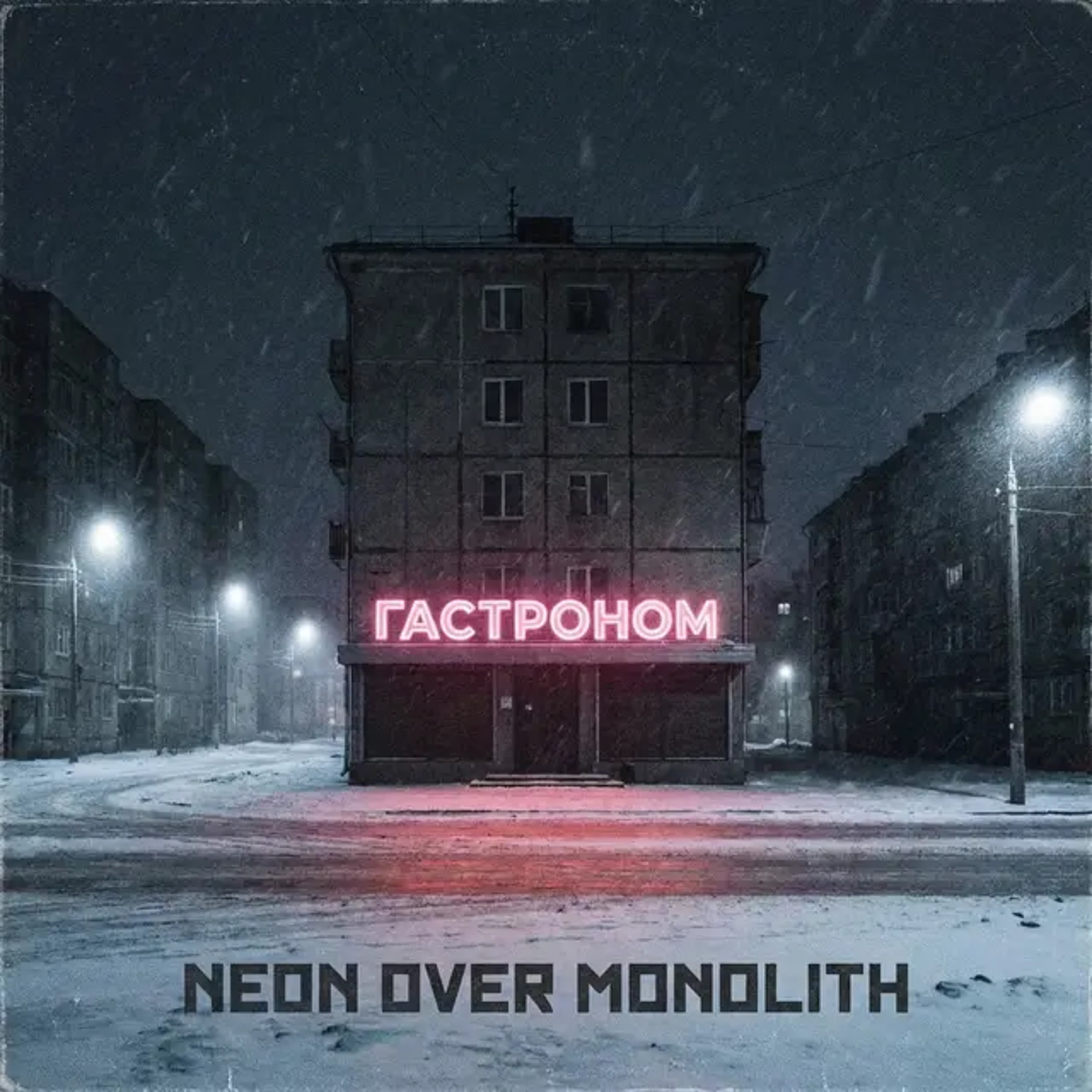
The gastronom is a state food store, not a brand. A word that means "gastronome" and describes a place where you queue for sausage, bread, tinned fish, and whatever came off the truck that morning. In the cities, by the 1970s, the signs above those doors were part of the street: red, green, sometimes pink, glass tubes bent into letters, a transformer buzzing behind the wall.
At seven in the morning the queue is already there: felt boots, shopping bags, breath in the air. The doors open at eight. Inside it smells of cardboard, cabbage, and disinfectant. A woman behind the counter weighs a piece of sausage on a scale with a swinging arm, wraps it in paper, and the queue shuffles forward.
A neon letter is fragile. Glass, gas, a small transformer, a lot of weather. One tube dies and the word stutters, the rest of it still burning. Pink light on dirty snow. A queue that does not look up.
Gas-tro-nom
The riff drops out.
The tempo jumps. The guitars go rockabilly, all bright arpeggios and slap, double-kick underneath, a hiccup in the vocal. The sign becomes a chant — "Gas-tro-nom, oh-oh" — three hits, a hand on the switch, the whole street pink.
"You're burning in the snow." A storefront in February. Minus twenty. The tube glowing so hard the snow beneath it looks warm.
Then the second pass: "Gas-tro-nom, uh-huh / A fever and a glow." The chorus is grinning. It knows the city is stone. It dances anyway.
"In a city made of stone / I'm dancing on my own." Breath in the air, boots on packed snow. Then the last chorus: "We're dancing, not alone." Same street. Same sign. More people in it.
Inside the Stone, a Beating Heart
The bridge slows everything down.
Inside the cold, a secret heat
Inside the stone, a beating heart
Every tower hides a flame
Every window hides a spark
Look up. That is what the blocks look like at night: a hundred thousand windows, most of them lit, each one a kitchen, a television, a kettle, a child asleep against the radiator. The monolith is not a monument. It is a place where people hung curtains.
The blizzard comes back as a thrash-shuffle, an upright bass locked to the kick, a chant — "Freezing, burning, freezing, burning / Round and round the towers turning / Freezing, burning, spinning higher / Snow on fire, snow on fire." The snow is not putting the neon out. It is catching it.

Still Glowing
The song ends with the sign still on — "Gas-tro-nom, still glowing / Still glowing" — and a last "take me home" before the wind takes the rest.
The country that built the blocks is gone. The blocks are not. Millions of people still live in them, from Murmansk to Vladivostok. The paint peels. The elevator stops between floors. The store downstairs is a Pyaterochka or a phone shop, and the old sign is gone, or under glass, or rusting in a yard. But on a winter night, in a courtyard that looks like every other courtyard, a window is still pink.
Nine floors high. Ninety wide. One light on.
— Anton Ignatov
Listen on your platform


