
From the Frontline
The In-Tray Is Already a Crime Scene: The True Story Behind "NKVD"
Published November 14, 2026 · by Anton Ignatov
The song behind the story
NKVD
The song begins at midnight, with a man clocking in. His paperwork is a crime, his coffee is stale, his filing cabinet is jammed with enemies of state, and somewhere upstairs Stalin wants a purge by five. He is not a monster. He is a middle manager with a deadline.
That is the joke of "NKVD", and it is also the most accurate thing about it. The Soviet secret police was a bureaucracy before it was anything else: departments, canteens, typists, stationery requisitions, salaries, a plan. The horror of the Great Terror was not that it was run by lunatics in a cellar. It was that it was run like an office — and the office kept records.
The NKVD, the People’s Commissariat for Internal Affairs, existed from 1934 to 1946. In those twelve years it helped build the Gulag, deported entire nations, shot Polish officers in the Katyn forest, and, in 1937 and 1938, executed 681,692 people according to its own records. This is the history behind the song’s working day.
Clocking In at Midnight
"Clocking in at midnight, the paperwork’s a crime / Got a quota for the Gulag, and I’m running out of time."
The NKVD was created on 10 July 1934, when the OGPU — the secret police that had grown out of the Cheka — was folded into the commissariat that already ran the militia, the fire brigades and the border troops. Its first chief was Genrikh Yagoda, a career security man who would be shot in 1938. In September 1936 he was replaced by Nikolai Yezhov, under whom the Great Terror reached its height. In November 1938 Lavrentiy Beria took over.
The headquarters was the Lubyanka, a grey building on a square in the centre of Moscow, with a prison in the basement and the inner courtyard. The NKVD had departments for state security, for the camps, for the police, for transport, for the border. It had its own troops. It had a supply department that ordered paper by the tonne. The files were the point: an arrest was a form, an interrogation was a protocol, a sentence was a sheet of paper with three signatures.
The song’s clerk is a fiction. His desk is not. The NKVD’s officers worked with quotas, reports and "cases" — thick cardboard folders sewn shut with string. The centre demanded numbers; the regions supplied them; the numbers were typed, signed and filed. When historians later reconstructed the Terror, they did it from those files. The NKVD’s own statistics record 681,692 executions in 1937 and 1938, and around one and a half million arrests.
A Quota with Your Name on It
"Comrade Ivanov says his neighbor stole a hen."
On 30 July 1937 the NKVD issued Order No. 00447, "On the operation to repress former kulaks, criminals and other anti-Soviet elements". It was approved by the Politburo and signed by Yezhov. It divided the people to be repressed into two categories: the first, to be shot; the second, to be sent to the camps. It set ceilings for every region. And it named the troikas — the three-man commissions of the local NKVD chief, the party secretary and the prosecutor — that would pass the sentences.
The order was a plan in the ordinary sense. It had a start date, 5 August 1937, and a deadline of four months. It had columns for the first and second categories and a line for the total. The Byelorussian SSR, for example, was allocated 2,000 executions and 10,000 camp sentences. The limits were not to be exceeded without Yezhov’s personal approval, which in practice was easy to obtain.
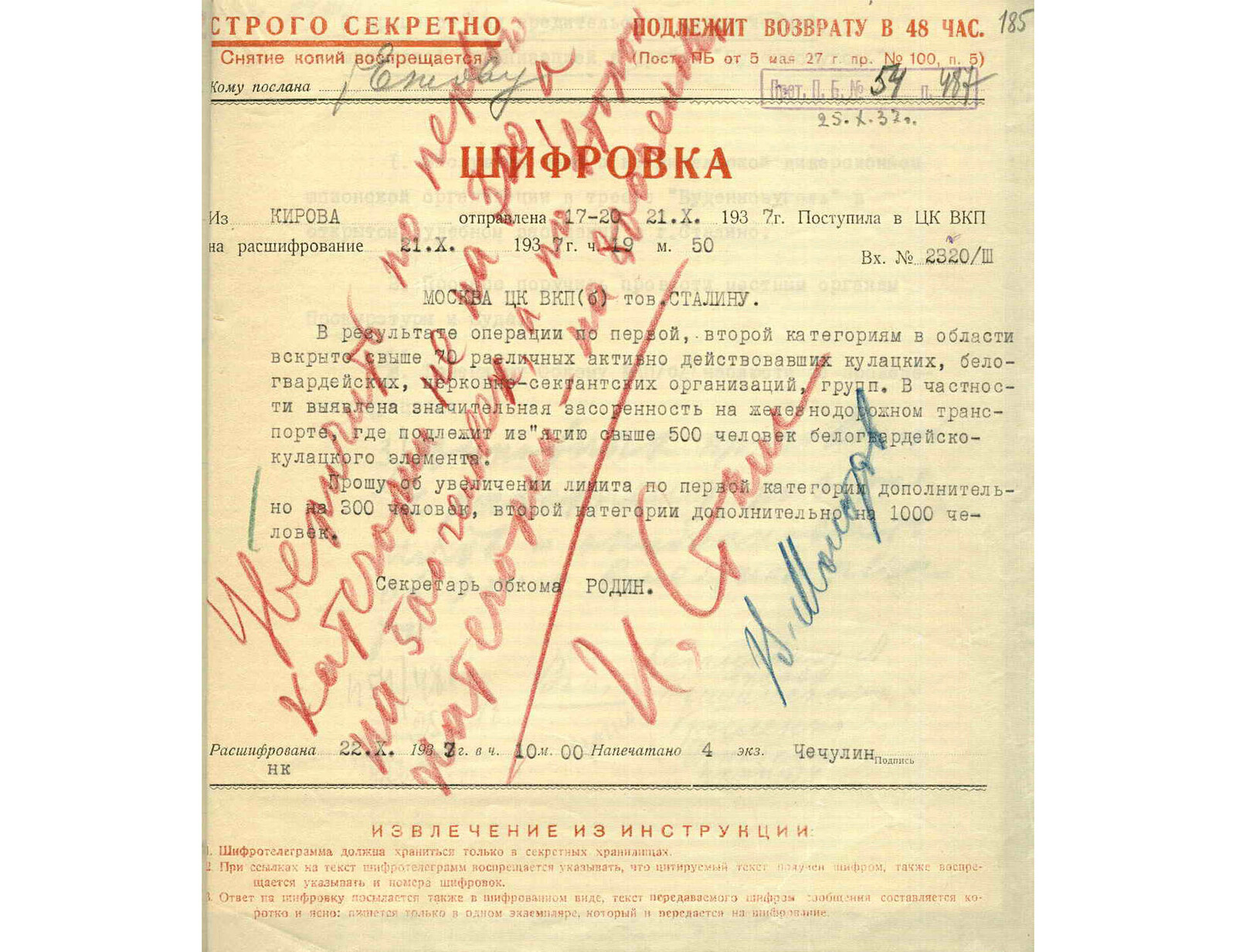
Here is how easy. On 21 October 1937 the party secretary of the Kirov region sent Stalin a cipher telegram: the operation had uncovered more than seventy "kulak, White Guard and sectarian" groups, more than five hundred people were to be removed from the railways, and he asked to raise the first-category limit by 300 and the second by 1,000. The tone is that of a branch manager asking for more stock. The request went to Stalin because only he could raise the ceiling, and his resolution is scrawled across the page in red pencil. Three hundred more people to be shot. One thousand more to be sent to the camps. It reads like a requisition for stationery, approved at the top.
Multiply that by every region and every month. In July 1938 the NKVD chief of the Omsk region asked for an increase of thousands of executions because his men had already fulfilled the plan. Stalin approved it and promoted him. By the end of 1938, 386,798 people had been shot under Order 00447 alone.
The song’s stolen hen is not a detail. Denunciations came from neighbours, colleagues, spurned lovers and people with a grudge over a fence. A careless word about the collective farm, a foreign stamp on a letter, a cousin who had been a merchant in 1913 — under Article 58, the article on counter-revolutionary activity, almost anything could be made to fit. The NKVD did not need evidence. It needed a file.
And when the files ran short, the quotas were filled anyway. In the autumn of 1937, interrogators in some regions began picking names out of the telephone directory. They looked for married men with children, because, as every agent knew, they confessed fastest.
The Basement’s Getting Crowded
"The basement’s getting crowded, the interrogations drag / I just want a paid vacation and maybe a new bag."
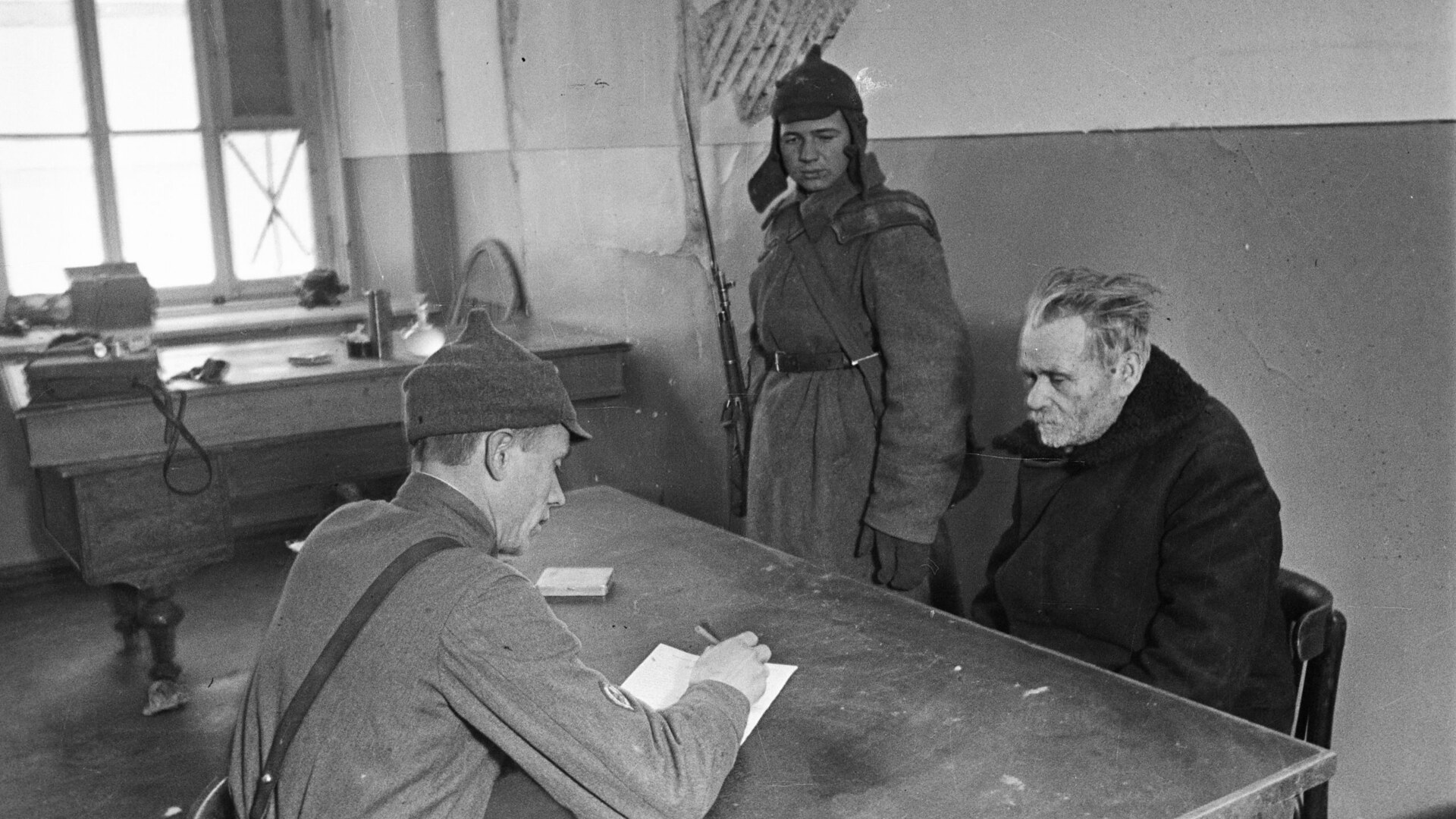
The photograph at the top of this article was taken in Kerch in January 1942 by Yevgeny Khaldei, the Red Army photographer who would later photograph the flag over the Reichstag. A man in a soldier’s cap sits at a table, writing. A guard with a rifle stands behind him. Across the table, a prisoner in a heavy coat waits. The room is ordinary: a window, a bench, a bare bulb. That is what the machinery looked like from the inside — a table, a form, a man with a pen.
At the Lubyanka, the interrogation rooms were in the basement. The methods were the ones the twentieth century perfected: the conveyor, in which teams of interrogators worked in shifts for days; sleep deprivation; standing for hours; cold; beatings. The confession was the product, and the confession had to name others, because a case was not finished until it had a network. The trial, when there was one, was a formality: a troika or the Military Collegium, a few minutes, a sentence decided in advance.
On 20 August 1937, Stalin signed one of the execution lists: page after page of names, typed in alphabetical order, with the sentence beside each one. Lists like it were signed by Molotov, Voroshilov, Kaganovich and Zhdanov. The people on them were shot within days. The document in the second image is a different kind of paper: a regional request for more executions, with the answer written across it. The two documents belong together. One is the order; the other is the receipt.
The killing was industrial and it was hidden. At Butovo, a former estate south of Moscow, the first 91 prisoners were brought from the city prisons on 8 August 1937. Over the next fourteen months, 20,761 people were shot there and buried in trenches. The busiest day was 28 February 1938, when 562 people were killed. The last 52 were shot on 19 October 1938. At Kommunarka, a few kilometres away, another 10,000 to 14,000 were buried. The sites were levelled, planted with trees and forgotten until the archives opened.
Since 1995, Butovo has been a memorial. The names are read aloud. There are more than twenty thousand of them, and they are only Moscow’s share.
The Black Raven
"Guess I’ll warm up the Black Raven, we are riding out again."
The Black Raven — Чёрный воронок — was the nickname of the van that came for people at night. The best-known of them were GAZ-M1s, the Soviet version of the Ford Model B, built at Gorky from 1936. In their police version the rear windows were replaced with metal or frosted glass, the bench inside had no light, and the doors opened only from the outside. The van was black, boxy and unmistakable.
The nickname echoed an old song. Чёрный ворон — the black raven — is a Russian folk song about a crow circling a dying soldier on a battlefield. In the courtyards of Moscow, the bird became a car. People learned to recognise the sound of the engine, the way it idled by the entrance, the time of night it came. A knock, a name, a coat, a bag, and the door of the van closing.
The van is the exact point where the paperwork becomes a grave. In the file, a person is a card with a number. In the van, a person is a body on a bench, travelling to Butovo, to Kommunarka, to a station on the Trans-Siberian line and a camp in Kolyma. The van is the last room of the office.
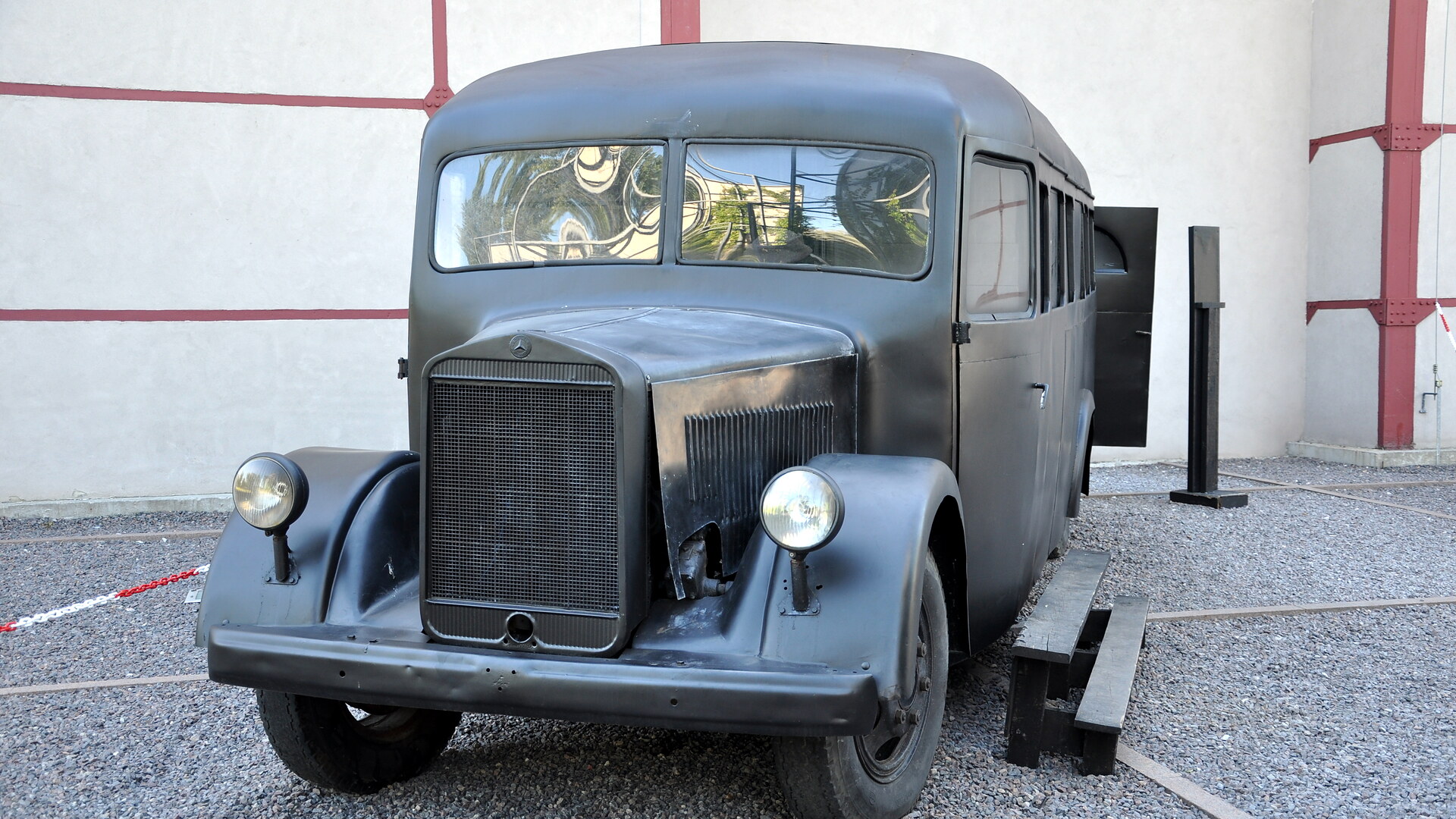
The van in the photograph is a reconstruction, built for Andrzej Wajda’s film Katyn (2007) and displayed at the Katyn Museum in Warsaw. It is a German-built vehicle of the kind used in the 1940 Katyn transports, not a GAZ, but the shape is right: a black box on wheels, a small window, a door that opens only from outside. Photo: Halibutt, CC BY-SA 3.0, via Wikimedia Commons.
A Purge by Five
"Stalin wants a purge by five, the deadlines are absurd / If I hear another false confession, I will flip the bird."
The deadlines were real. The mass operations ran on plans, the plans ran on quotas, and the quotas ran on the careers of the men who filled them. A regional chief who fell short was in trouble; a regional chief who oversaw more arrests was promoted. The system did not need sadists, though it found them. It needed people who wanted to keep their jobs.
Yezhov ran the NKVD for two years. In December 1938 he was replaced by Beria, and on 4 February 1940 he was shot. Yagoda, his predecessor, had been shot on 15 March 1938. Beria was executed in December 1953, after Stalin’s death. The machine that ate the country also ate its managers: in 1938 and 1939, a large part of the NKVD’s own officer corps was dismissed, arrested or shot. The clerk in the song is afraid of the quota for a reason. The quota was also a test of him.
The narrator is not a good man and not a monster. He is tired, underpaid and worried about his dinner date. That is the sharpest thing about the lyric. The great crimes of the twentieth century were not committed by people who looked like villains. They were committed by people who had a desk, a supervisor and a mortgage, and who went home at the end of the shift.
After the war the NKVD became the MVD; in 1954, state security was split off as the KGB. The Lubyanka passed from one set of initials to another. The building is still there, and the files — the ones that survived — are still there too.
Next.
The song ends with a single word: Next. It is what the clerk says to the next person in the queue. It is also how the machine moved on: one name after another, one file after another, one night after another.
"NKVD" is a satire, and satire is the only tone that fits a bureaucracy of murder. But the song is not only a joke about the past. It is a joke about the kind of person who fills in the form, keeps the numbers up and does not look at the portrait on the wall. The portrait changes. The form is always the same.
The files are open. The names are known. The black raven is in a museum now, behind a rope, with a label. The queue, in the song, never ends. Next.
— Anton Ignatov
Listen on your platform


